
Sometimes, the most powerful call to faith is not heard with the ears, but witnessed with the heart. Long before a seeker understands the doctrines of a religion, they can be profoundly moved by the tangible character of its people. This story follows the journey of a young man whose path to Islam began not with a book, but with the observable love and unity among his Muslim peers, a living testament to the Prophet’s saying: “The believers in their mutual kindness, compassion, and sympathy are just like one body…” (Al-Bukhari).
This is the story of BUTOYI Diomede. He was born, raised, and educated in the countryside, a setting where his worldview was initially shaped by the majority Christian community to which he belonged. After completing secondary school, seeking broader horizons, he made the significant move to the urban center of Bujumbura in search of better opportunities. However, the seed of his transformation had been planted long before this move, during his school years.
He recalls, “At the school where I studied, there were Christians, including myself, and Muslims who were in the minority. What struck me most was how the Muslims behaved differently. They genuinely loved and supported each other in a way that was distinct and visible.”
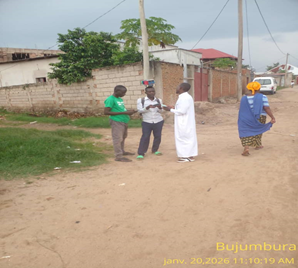
This observable brotherhood (Ukhuwah Islamiyah) became a source of deep intrigue and attraction for Diomede. It raised a fundamental question in his heart: what was the source of this powerful solidarity and mutual care? This profound impression affected him so deeply that it ignited a sincere desire within him to understand, and ultimately, to become a part of what he witnessed.
This desire turned into a persistent, internal quest. He began to discover Islam little by little, piecing together fragments of understanding. His journey, however, was met with a significant challenge: in the village where he grew up, there were few Muslims to turn to for guidance. The very community whose behavior had inspired him was not readily accessible for deeper instruction. Yet, the impression was so powerful that he did not give up. His yearning became a patient hope, tied to his ambition to move to the city.
His move to Bujumbura was thus not merely a search for economic opportunity, but the culmination of a spiritual search. In the city, he easily found what he had longed for: a vibrant Muslim community and numerous mosques. Here, the observations of his youth could finally be paired with knowledge. He sought out information, asked questions, and received the clear, comprehensive explanation of Islam that had been unavailable to him before. With his heart already prepared and his mind now enlightened, Diomede readily accepted Islam. Today, he is no longer an outside observer of that brotherhood; he is a committed and devoted young Muslim, an integral part of the very community whose love once guided him from afar. His story is a beautiful reminder that righteous conduct is a silent but potent form of dawah, capable of guiding a seeking heart across miles and years until it finds its home in faith